
BadHOA.com is an independent Arizona resource for homeowners who want to understand their rights under Arizona HOA law — chiefly Title 33 of the Arizona Revised Statutes, which governs planned communities (Chapter 16) and condominiums (Chapter 9).
Why BadHOA Exists
2008: A 20-Year-Old Chevy Cavalier

BadHOA started because of a car.
I was working from home, and my HOA’s management company sent a complaint that my vehicle was being “stored” on the property. My wife called to sort it out — and in the course of that conversation, the management company essentially admitted the truth: if the car in the driveway had been a BMW instead of a 20-year-old Chevy Cavalier, nobody would have said a word.
The rule wasn’t really about storage. It was about what the board and the management company thought a car in that driveway should look like.
2007: The Halloween Lights
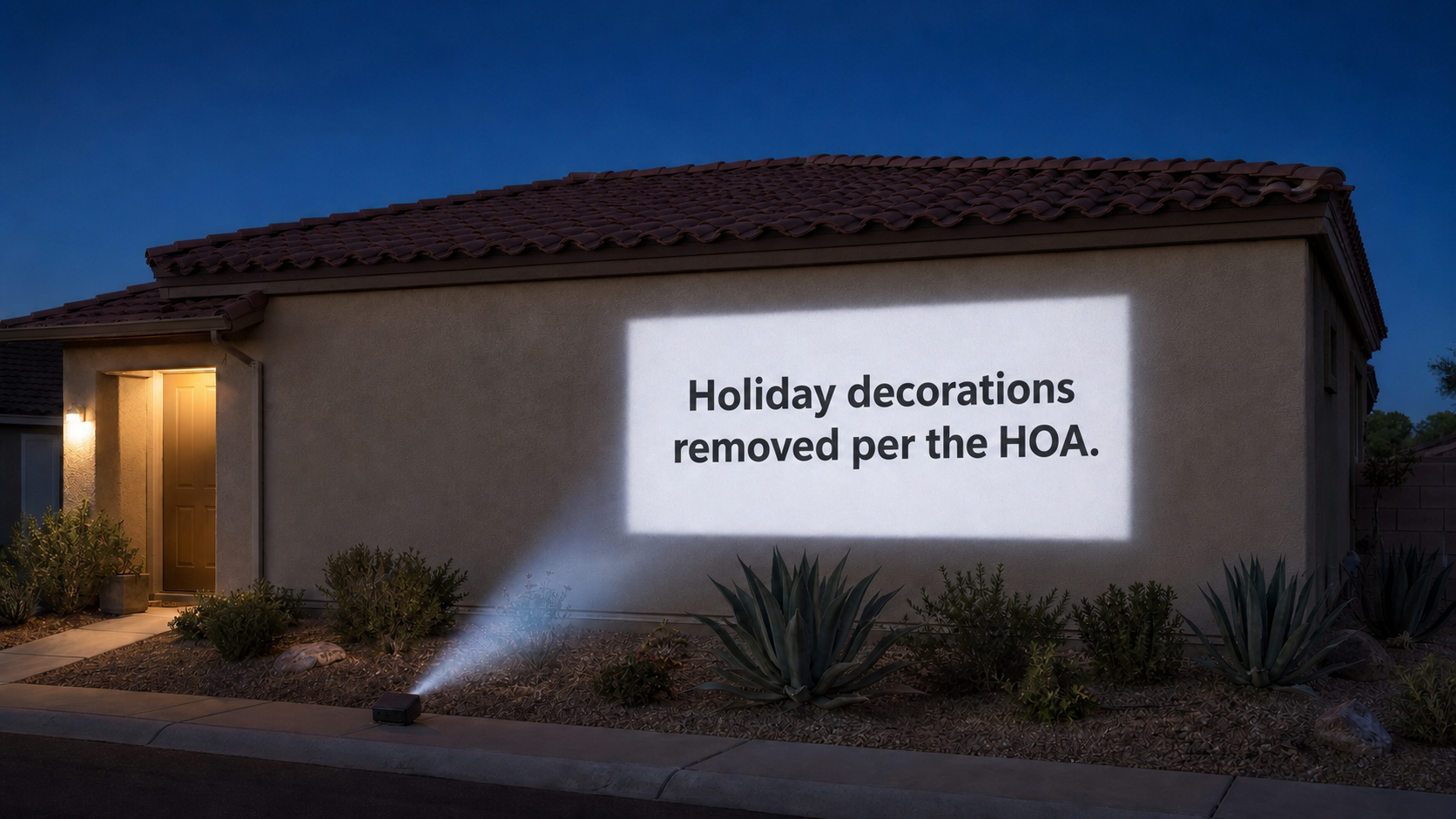
The year before, we’d already had a preview of how this HOA treated its own rules.
We’re decorators — Halloween and the fall season are a big deal in our house. That year, after Halloween, I took down the pumpkins, the decorations, everything except the string lights — and even those I changed, pulling the purple bulbs and leaving only the orange, then adding a fall wreath so the display read as autumn, not Halloween.
The HOA sent a letter anyway: the lights had to come down. Our thirty days were up. From here on, exterior decorations were to be for Thanksgiving.
So I complied — literally. I took down every light except one: a projector, aimed at the side of my house, facing the road everyone used to enter the complex. It read:
“Holiday decorations removed per the HOA.”
We never put up another display after that. Neighbors asked us to, for years. We didn’t. Compliance was the whole message.
Why This Still Matters
Those two incidents, a year apart, taught us the same lesson: the rule on paper and the rule as enforced are often two different things, and the gap between them is where HOAs and their management companies do the most damage. A car that violates nothing in writing gets a violation letter because of what it signals about the owner. A homeowner who complies with a letter to the exact word still gets treated as the problem.
That’s what BadHOA was built to document and fight.
Why We Rebuilt It

We’ve since moved to a different Arizona HOA — and watched enough of the same patterns play out here to know 2008 wasn’t one bad manager at one bad company. In Arizona specifically, it’s closer to how the system is built and where the gaps in oversight actually sit.

Arizona’s conflict-of-interest law is a disclosure rule, not a prohibition. The Planned Communities Act (A.R.S. § 33-1801 et seq.) governs Arizona HOAs, and its board-conflict provisions require a board member or manager to declare a conflict of interest — but once declared, the law doesn’t stop the transaction from happening. A board member or a management company can have a financial relationship with a vendor, an attorney, or a collections agency doing business with the association, and as long as it’s disclosed, Arizona law lets it proceed. That’s the loophole homeowners run into again and again: the paperwork is clean, and the conflict happens anyway, in plain sight.

Nobody at the state level is actually watching the management companies. The Arizona Department of Real Estate licenses individual community managers, but ADRE is explicit that it does not regulate HOAs, HOA boards, or HOA management companies themselves. If a board rubber-stamps whatever its management company recommends — including which collections firm or which attorney gets the file — there is no state agency reviewing that decision on the homeowner’s behalf. The only formal path is the ADRE HOA Dispute Process (A.R.S. Title 32, Ch. 20, Art. 11), and that’s an after-the-fact venue a homeowner has to know exists and choose to use.

The collections pipeline is where the real money moves. Arizona law (A.R.S. § 33-1807, § 33-1808) lets associations file liens and pursue foreclosure over unpaid assessments, and requires 30 days’ written notice before an attorney or outside collection agency can start collection activity. That 30-day window is supposed to be a homeowner’s chance to resolve a small balance before it becomes a legal matter. In practice, once a file crosses that line into a collections agency or law firm the management company has a standing relationship with, the fees attached to that file can quickly exceed the original assessment or fine — and the homeowner is now negotiating with a business partner of the very company that sent the first letter, not a neutral third party. Federal law recognizes this dynamic too: a management company whose real focus is collecting unpaid assessments and enforcing liens has a good chance of being treated by a court as a “debt collector” in its own right under the Fair Debt Collection Practices Act — not a neutral administrator.

Boards are volunteers being told this is just “how it’s done.” Arizona board members are homeowners, not lawyers, and they rely almost entirely on the management company for guidance on process. When that company’s revenue is tied to how many files move through violations and into collections, “this is standard practice” is advice coming from the party that profits from the volume — not a neutral read of what A.R.S. Title 33, Chapter 16 actually requires.
None of this requires every Arizona board member or every management company to be acting in bad faith. Many aren’t. But between a disclosure-only conflict rule, a state agency that doesn’t regulate the management companies themselves, and a collections pipeline with real money attached, the structure rewards exactly the pattern we ran into in 2008 — and it does so at scale, in communities where homeowners don’t know their governing documents and Arizona statute give them more leverage than they’re being told they have.
What BadHOA Is Now
BadHOA.com isn’t a lights display anymore. It’s a resource for Arizona homeowners who are getting the letter we got — the one that’s technically about a rule, but really about something else — and don’t know yet that Arizona’s Planned Communities Act usually gives them more room to push back than the HOA or its management company wants them to know about.
People should not have to pay a mortgage and still live under a landlord.
We built this site because eighteen years ago, the fastest way to make a point was a projector and a plain white sheet. Today, it’s making sure every homeowner who searches for help finds it before the fine becomes a lien, and the lien becomes a lawsuit they never saw coming.
Independent and unaffiliated
We are not affiliated with, endorsed by, or connected to any law firm, attorney, homeowners association, community management company, or governing body. The perspective offered here is that of an independent homeowner advocate.
Noncommercial
This site collects no money. There is no cart, no checkout, no fees, no paid memberships, and no advertising. We sell nothing and take no payments of any kind.
Not legal services, not legal advice
We do not provide legal services and we do not give legal advice. The material on this site — statutory citations, filing deadlines, and document templates — is general information only, and using it does not create an attorney-client relationship. For guidance on your specific circumstances, consult a qualified Arizona attorney.
What we provide
- HOA Laws — plain-English summaries of every Arizona statute that governs your association, each with a citation to source and its current effective date
- Bill Tracker — every Arizona HOA bill at the Legislature: what it actually does, the statutes it changes, its status and effective date, who sponsored it, and whether it helps or hurts homeowners
- Report Card — accountability grades for legislators, lobbyists, PACs, management companies and law firms, judged on one question: do they work for homeowners, or for the people making money off them
- Look Up Your HOA — the public record on your association: management company, statutory agent, and board officers
- Free tools — a deadline calculator, response-letter and records-request generators, an ADRE petition walkthrough, and plain-English answers to “Can My HOA Do That?”
- Printable letter and records-request templates homeowners can adapt, and deadline references drawn directly from the statutes
- Arizona HOA news we track and link back to the source, plus accountability reporting and plain-language explainers
Paying a Mortgage Shouldn’t Mean Living Under a Landlord.